













Skip to Content
800-533-8762
  • Careers
  • Newsroom
  • Health Care Professionals
  • About Us
  • Contact Us
UPMC
  • Find a Doctor
  • Conditions
  • Services
    • Frequently Searched Services
    • Frequently Searched Services
      Allergy & Immunology Behavioral & Mental Health Cancer Ear, Nose & Throat Endocrinology Gastroenterology Heart & Vascular Imaging Neurosciences Orthopaedics
      Physical Rehabilitation Plastic & Reconstructive Surgery Primary Care Senior Services Sports Medicine Telemedicine Transplant Surgery Walk-In Care Weight Management Women’s Health
      See all Services
    • Services by Region
    • Find a UPMC health care facility close to you quickly by browsing by region.
      UPMC in Western Pa. Western Pa. and New York
      Highlighted Regional Map of UPMC in Central Pa. Central Pa.
      UPMC in North Central Pa. North Central Pa.
      UPMC in Western Md. Maryland & West Virginia
    • See All Services
  • Locations
    • Locations by Type
    • Locations by Type
      UPMC hospitals
      Hospitals
      Physical Therapy
      Physical Therapy
      Urgent care
      Walk-In Care
      UPMC Outpatient Centers
      Outpatient Centers
      UPMC Imaging Services
      Imaging
      Community Health Centers
      Community Health Centers
      See All Locations
    • Locations by Region
    • Locations by Region
      UPMC in Southwest Pa. Southwest Pa.
      UPMC in North Central Pa. North Central Pa.
      UPMC in Northwest Pa and Ny. Northwest Pa. & Western N.Y.
      UPMC in West Central Pa. West Central Pa.
      Highlighted Regional Map of UPMC in Central Pa. Central Pa.
      UPMC in Western Md. Maryland & West Virginia
    • See All Locations
  • Patients & Visitors
    • Patient & Visitor Resources
    • Patient & Visitor Resources
      Patients and Visitors Resources Pay a Bill Classes & Events Health Library International Traveling Patients Medical Records
      Patient Information Patient Portals Privacy Information Shared Decision Making Visitor Information
      Man uses mobile phone
      Pay a Bill
      Nurse reviews medical chart
      Request Medical Records
  • Patient Portals
  • Find Covid-19 updates
  • Schedule an appointment
  • Request medical records
  • Pay a bill
  • Learn about financial assistance
  • Find classes & events
  • Send a patient an eCard
  • Make a donation
  • Volunteer
  • Read HealthBeat blog
  • Explore UPMC Careers
Skip to Content
UPMC
  • Find a Doctor
    • Doctor Search
  • Conditions
    • Search Conditions We Treat
  • Services
    • Frequently Searched Services
      • Heart and Vascular Services
      • Neurosciences Services
      • Orthopaedics Services
      • Primary Care Services
      • Spine Care Services
      • Sports Medicine Services
      • Transplant Services
      • Women's Health Services
      • See all Services
    • Services by Region
      • Find Care in Western Pa
      • Find Care in Central Pa
      • Find Care in North Central Pa
      • Find Care in Western Maryland
    • See All Services
  • Locations
    • Locations by Type
      • Hospitals
      • Walk-In Care
      • Imaging
      • Physical Therapy
      • Outpatient
      • Community Health Centers
      • See All Locations
    • Locations by Region
      • Central Pa.
      • Maryland and West Virginia
      • North Central Pa.
      • Northwest Pa. & Western N.Y.
      • Southwest Pa.
      • West Central Pa.
    • See All Locations
  • Patients & Visitors
    • Patient & Visitor Resources
      • Pay a Bill
      • Classes & Events
      • Health Library
      • International Traveling Patients
      • Medical Records
      • Patient Information
      • Patient Portals
      • Privacy Information
      • Shared Decision Making
      • Visitor Information
      • View All Patients and Visitors Resources
  • I Want To
    • Find Covid-19 updates
    • Schedule an appointment
    • Request medical records
    • Pay a bill
    • Learn about financial assistance
    • Find classes & events
    • Send a patient an eCard
    • Make a donation
    • Volunteer
    • Read HealthBeat blog
    • Explore UPMC Careers
  • Patient Portals
  • Careers
  • Contact Us
  • Newsroom
  • UPMC >
  • Conditions >
  • Vulvar Cancer

​Vulvar Cancer

Vulvar cancer is a slow-growing and rare cancer. It forms in the tissues that make up the vulva — the outer part of the female genitals that includes the clitoris, the inner and outer labia, and the opening of the vagina.

Looking for Vulvar Cancer Care?

Related services:
  • Gynecologic Cancer.
  • Primary Care.
  • Women's Health.
Find a Provider

On this page:

  • What Is Vulvar Cancer? 
  • What Are the Signs and Symptoms of Vulvar Cancer?
  • How Do You Diagnose Vulvar Cancer? 
  • How Do You Treat Vulvar Cancer?

What Is Vulvar Cancer? 

Vulvar cancer is a type of cancer that forms slowly in the tissues that make up the vulva — the outer part of the female genitals.

The vulva includes the:

  • Clitoris.
  • Inner and outer labia.
  • Opening of the vagina.

Most often, vulvar cancer forms on the inner edges of the vaginal lips or the sides of the vaginal opening.

A human papillomavirus (HPV) infection can increase your risk of developing vulvar cancer, but not everybody with HPV will develop vulvar cancer.

Early detection is important with vulvar cancer. While pap smears may not detect an HPV infection of the vulva, routine physical exams by a gynecologist can help detect any new, suspicious lesions.
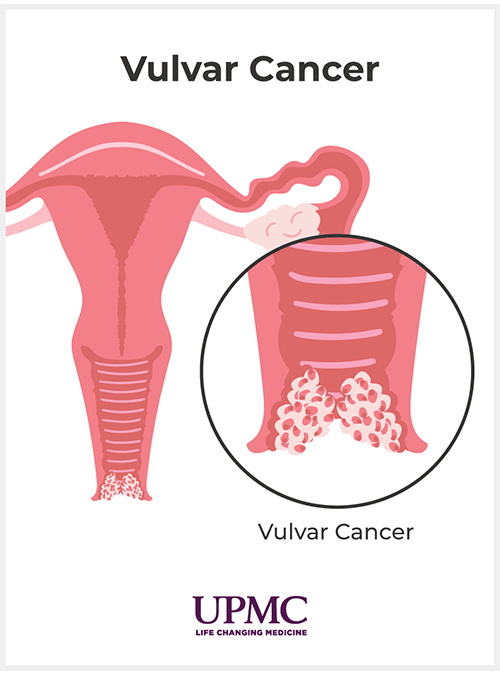
Vulvar cancer diagram.

How common is vulvar cancer?

Vulvar cancer is very rare. Vulvar cancer and vaginal cancer combined account for about 7% of all gynecologic cancers in the U.S. each year.

According to the Centers for Disease Control and Prevention (CDC), in 2020:

  • 5,276 women (2.5 per 100,000 women) were diagnosed with vulvar cancer.
  • 1,466 women (0.6 per 100,000 women) died from vulvar cancer.

What are the types of vulvar cancer? 

The most common types of vulvar cancer are:

  • Squamous cell carcinoma — Occurs in the squamous cells that make up the vulva, and is the most common type of vulvar cancer.
  • Adenocarcinoma — Develops in the glands near the vulva.
  • Melanoma — A kind of skin cancer that starts in the melanocytes, the cells that make pigment in the skin.

What causes vulvar cancer?

Doctors don't always know what causes vulvar cancer, but HPV causes about 50% of cases.

Back to top

Vulvar cancer risk factors

Certain factors may increase your risk of developing vulvar cancer.

These include:

  • Age — 80% of vulvar cases happen in people age 50 or older. Half are in women over 70.
  • Previous gynecologic cancer — You're at a higher risk of vulvar cancer if you've had cervical cancer.
  • Sexual history — First having sexual intercourse at a young age can increase your risk of vulvar cancer, as can having multiple partners.
  • History of vulvar intraepithelial neoplasia (VIN) — But not everyone with these precancerous changes will develop vulvar cancer.
  • HPV — Some HPV types have been linked to vulvar cancer.
  • HIV — This virus damages your immune system, making it easier for you to get HPV and harder for your body to clear the infection as well as fight cancer.
  • Skin conditions involving the vulva — A disorder called lichen sclerosus et atrophicus (LSA) makes the vulvar skin very thin and itchy and may slightly increase your risk of vulvar cancer.
  • Smoking — Your risk of developing vulvar cancer increases if you smoke, even more so if you have a history of HPV.

Back to top

Complications of vulvar cancer

Treatment for vulvar cancer can lead to complications, including lymphedema if surgeons also remove the lymph nodes in your groin.

Female sexual dysfunction is also possible following surgery for vulvar cancer. This may include an inability to achieve orgasm and painful intercourse.

Back to top

How can I reduce my risk of vulvar cancer?  

The best way to reduce your risk of vulvar cancer is to get the HPV vaccine if you're eligible. Consider the vaccine for your teens, too, to protect them in the future.

The HPV vaccine protects against the types of HPV that can cause cervical, vaginal, and vulvar cancers, as well as some head and neck cancers.

Continue to get screened for cervical cancer regularly, even if you’ve received an HPV vaccine.

Back to top

What Are the Signs and Symptoms of Vulvar Cancer?

Symptoms of vulvar cancer may include:

  • Abnormal and consistent itching in the vulva.
  • Abnormal vaginal bleeding.
  • A lump in the vulva.
  • Tenderness in the vulva.

Vulvar cancer may develop as a new mass on the vulva. The mass may not cause any symptoms.

  • Or it may:
  • Be itchy.
  • Be painful.

Cause occasional vaginal spotting.

Back to top

How Do You Diagnose Vulvar Cancer? 

To diagnose vulvar cancer, your doctor will take your medical history and ask about your symptoms.

They'll also likely do a pelvic exam — also called an internal exam — to look at and feel the vulva, vagina, and cervix. During the exam, they may do Pap and HPV tests.

Tests to diagnose vulvar cancer

If your doctor sees anything abnormal, they'll do a biopsy to remove the suspicious tissue and then examine it under a microscope.

They may also order imaging tests, such as:

  • CT scan
  • PET scan
  • MRI

Back to top

How Do You Treat Vulvar Cancer?

Surgery is the main treatment for vulvar cancer. Your surgeon will consider your ability to have a healthy sex life post-cancer when deciding how much tissue to remove.

Surgery for vulvar cancer

Common surgeries for vulvar cancer:

  • Laser surgery — If you have VIN, your surgeon can use a laser beam to burn off the vulvar skin layer with the precancerous cells.
  • Lymph node surgery — Your surgeon may need to remove the pelvic lymph nodes, where vulvar cancer often spreads. They may also do a sentinel lymph node dissection to learn if the cancer has spread.
  • Vulvectomy/excision — Your surgeon will remove all or part of your vulva. Reconstructive surgery can be done after an extensive vulvectomy.

You may have radiation therapy following surgery to continue to shrink the tumor.

Chemo and radiation for vulvar cancer

If surgery isn't possible due to the size or location of your tumor, your doctor may recommend a combination of chemotherapy and radiation therapy.

Back to top

Why Choose UPMC for Vulvar Cancer Care? 

Through the UPMC Gynecologic Cancer Program, you have access to additional treatment options and services, including:

  • Behavioral health.
  • Clinical trials.
  • Fertility preservation.
  • Integrative, holistic medicine.
  • Supportive care for you and your family.
  • Women's Inclusive Sexual Health Clinic (WISH).

Back to top

  • Vulvar Cancer—Patient Version, National Cancer Insititute.
  • Vaginal and Vulvar Cancer Basics, CDC.
  • Risk Factors for Vulvar Cancer, American Cancer Society.

By UPMC Editorial Team. Reviewed on 2026-04-06.

2026-04-06
2026-04-21
Vulvar Cancer
A type of cancer that starts in the vulva, the outer part of the female genitalia. Symptoms may include itching, pain, and changes in the skin.
UPMC
200 Lothrop Street Pittsburgh, PA 15213

412-647-8762 800-533-8762

Patients And Visitors
  • Find a Doctor
  • Locations
  • Pay a Bill
  • Patient & Visitor Resources
  • Disabilities Resource Center
  • Services
  • Medical Records
  • No Surprises Act
  • Price Transparency
  • Financial Assistance
  • Classes & Events
  • Health Library
Health Care Professionals
  • Physician Information
  • Resources
  • Education & Training
  • Departments
  • Credentialing
Newsroom
  • Newsroom Home
  • Inside Life Changing Medicine Blog
  • News Releases
About
  • Why UPMC
  • Facts & Stats
  • Supply Chain Management
  • Community Commitment
  • Financials
  • Supporting UPMC
  • HealthBeat Blog
  • UPMC Apps
  • UPMC Enterprises
  • UPMC Health Plan
  • UPMC International
  • Nondiscrimination Policy
Life changing is...
Follow UPMC
  • Contact Us
  • Website/Email Terms of Use
  • Medical Advice Disclaimer
  • Privacy Information
  • Active Privacy Alerts
  • Sitemap
© 2026 UPMC I Affiliated with the University of Pittsburgh Schools of the Health Sciences Supplemental content provided by WebMD Ignite. To learn more, visit webmdignite.com.
Find Care
Providers
Video Visit
Portal Login

Chat Keywords List

  • cancel or exit: Stops your conversation
  • start over: Restarts your current scenario
  • help: Shows what this bot can do
  • terms: Shows terms of use and privacy statement
  • feedback: Give us feedback
Continue
Chat with UPMC
RESTART
MENU
CLOSE