















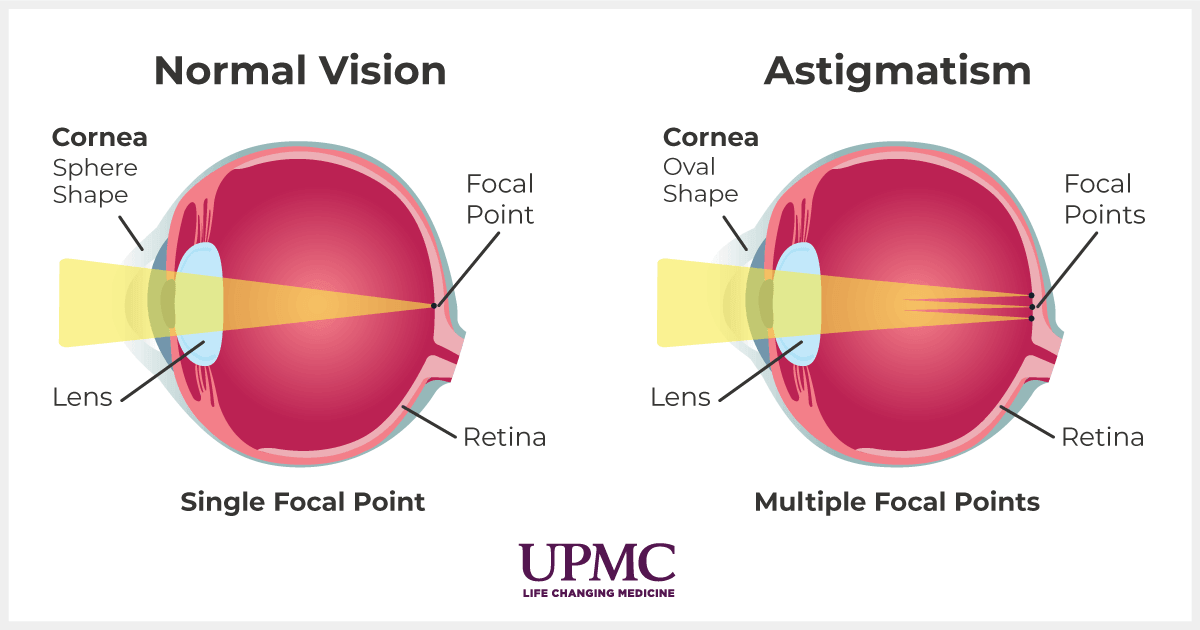
Astigmatism is a common condition of the eye. It occurs when the cornea — or sometimes the lens — has an irregular shape. Instead of being perfectly round, it’s oblong, like a football.
As a result, the eye doesn’t bend light correctly. This refraction error makes vision blurry at all distances.
While you can’t prevent astigmatism, your provider can easily treat it with glasses, contact lenses, or laser surgery.
On this page:
What Is Astigmatism?
Astigmatism is a refractive disorder. Refractive disorders prevent the eye from refracting, or bending, light properly, resulting in blurry vision. In this case, it happens because the cornea — or sometimes the lens — has an irregular shape. Instead of being perfectly round, it’s oblong, like a football.
Most cases of astigmatism are inherited from your parents and present at birth. However, you can also acquire astigmatism after an eye injury or surgery. As you age, the shape of the cornea and lens can change and result in an increase or decrease in astigmatism.
While astigmatism can’t be prevented, your provider can treat it with glasses, contact lenses, or laser surgery.
What are the types of astigmatism?
Your astigmatism may affect the cornea or the lens:
- Corneal astigmatism — Happens when the cornea has an abnormal shape. It is the most common type of astigmatism.
- Lenticular astigmatism — Happens when the lens has an abnormal shape.
Astigmatisms vary in shape. For example, your astigmatism may be horizontal or vertical:
- Horizontal astigmatism — When the eye is wider than it is tall, like a football laying on its side.
- Vertical astigmatism — When the eye is taller than it is wide, like a football standing on its end.
How common is astigmatism?
Astigmatism is very common and often, but not always, occurs with other refractive disorders, such as myopia (nearsightedness) or hyperopia (farsightedness).
What causes astigmatism?
Most people inherit astigmatism from their parents.
However, it does have other causes, including:
- Eye injury.
- Eye disease, especially a rare condition of the cornea called keratoconus.
- Eye surgery.
Astigmatism risk factors
You may be at higher risk of developing astigmatism if you have:
- A corneal disease, such as keratoconus.
- A family history of astigmatism.
- An eye injury or surgery.
Complications of astigmatism
Left undiagnosed or untreated, astigmatism can cause blurry vision, headaches, and eye discomfort. In children, it may lead to poor school performance due to blurry vision or amblyopia (lazy eye). It’s important have your child’s eyesight checked regularly, particularly if you have a family history of astigmatism.
But remember that glasses, contact lenses, or laser surgery can treat your astigmatism and help you avoid complications.
How can I reduce my risk of astigmatism?
Most cases of astigmatism are hereditary, so they can’t be prevented. However, eye injuries can also result in astigmatism, so it’s important to wear proper protective eyewear when you are taking part in activities like sports, housework, yard work, or industrial work.
What Are the Signs and Symptoms of Astigmatism?
If you have astigmatism, you may experience some or all of the following symptoms:
- Blurry vision.
- Distorted vision.
- Eye discomfort.
- Headaches.
- Needing to squint to see clearly.
When should I see a doctor about my astigmatism symptoms?
Because astigmatism creates blurry vision at any distance, it may hinder many of your daily activities, such as reading or driving. If you are experiencing blurry vision, headaches, or any other common symptoms of astigmatism, you should make an appointment with an ophthalmologist or optometrist. They can easily diagnose and treat astigmatism.
How Do You Diagnose Astigmatism?
Your provider can diagnose astigmatism with a thorough eye exam. They will take your medical history and ask you about your symptoms. Then, they will do an exam that includes tests for astigmatism.
Tests to diagnose astigmatism
- Eye chart test — Your provider will ask you to read letters on a chart or in a book. This allows them to determine how well you see at different distances.
- Keratometry or topography test — For a keratometry, your provider measures the curve of your cornea using a lighted device called a keratometer. Alternatively, your provider may use a corneal topographer to map the surface of the cornea in more detail. This is called a topography test.
- Refraction test — During this test, your provider will ask you to look through a phoropter, a device that resembles a set of large binoculars. They will then place a series of different lenses in front of your eyes and ask you which makes your vision clearer. Your prescription is based on your answers.
Astigmatism outlook
Glasses, contacts, and laser surgery correct astigmatism. However, your astigmatism can change over time, requiring a different prescription. Regular eye exams can help to address the changes as they occur.
How Do You Treat Astigmatism?
Correcting astigmatism requires you to wear glasses or contact lenses or to undergo laser eye surgery. You should talk with your provider about which treatment is best for you.
Eyeglasses or contact lenses for astigmatism
Glasses and contacts work by refocusing the light on the retina so that you can see more clearly.
- Contact lenses — Most contact wearers with astigmatism use special soft contact lenses called toric lenses or rigid gas-permeable lenses. Toric lenses provide different prescription powers across the lenses. Gas-permeable lenses maintain their rigid shape, which, in turn, helps the cornea maintain its shape.
- Glasses — Glasses use special cylindrical lenses that, much like toric contact lenses, allow for different prescription power across the lenses. Typically, this is done with single-vision lenses. As you age and lose the ability to focus on close objects, you may need bifocal lenses.
Laser eye surgery for astigmatism
Laser eye surgery works by using lasers to reshape the cornea. Once the cornea has a rounder shape, it can refract light better and offer clearer vision.
Typically, your provider will use LASIK or PRK. LASIK works by removing tissues from the inner layer of the cornea. PRK works by removing tissue from both the superficial and inner layers of the cornea.
Orthokeratology for astigmatism
Orthokeratology works by using a series of rigid contact lenses to reshape the cornea over time. Typically, you wear them overnight and take them out in the morning.
While this method is effective while you are using the lenses, if you stop using them, your cornea will return to its original shape.
How effective is treatment?
All the above treatments are effective for treating astigmatism. Which one you choose will depend on your lifestyle, comfort, and preferences. You should discuss these with your provider so that you get the treatment that meets your needs.
How long does it take to recover after treatment for astigmatism?
If you use glasses or contact lenses for your astigmatism, you will notice the difference as soon as you put them on or in your eyes. If you choose laser eye surgery, it will take a day or two to notice a difference, and your vision may continue to improve over the first few months.
Additional Common Questions
Is astigmatism the same as nearsightedness or farsightedness?
No. They are all refractive errors, meaning they cause the eye to bend light improperly, resulting in blurry vision.
But they have distinct differences:
- Astigmatism occurs when the cornea has an irregular shape, like a football. It leads to blurry vision at all distances.
- Farsightedness, or hyperopia, occurs when the eyeball is too short or the cornea is too flat and leads to blurry vision when viewing objects that are close.
- Nearsightedness, or myopia, is the opposite of hyperopia, and occurs when the eyeball is too long or the cornea too curved. It causes blurry vision when viewing objects that are far away.
Many people who have astigmatism also have myopia or hyperopia.
What questions should I ask my provider about astigmatism?
If you've been diagnosed with astigmatism, you may want to ask your provider the following questions:
- Which treatment for astigmatism is best for me?
- How will I know if my astigmatism has changed?
- Will my astigmatism lead to other issues with my eyes?
