















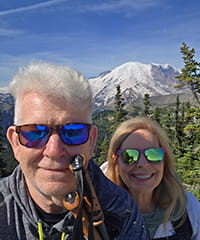
Brian is a father of five daughters and a retired computer programmer and analyst. Born and raised in south Texas, Brian has lived in Tulsa, Okla., for more than two decades. He enjoys hiking and camping with his family.
For most of his life, Brian has experienced good health.
"I didn’t spend a day in the hospital from the day I was born until my liver disease happened," he says.
Brian’s symptoms started slowly.
“I’d be in the middle of a hike and be like, ‘Man, I feel like I just ran into a wall,'" he says.
For two years, Brian’s symptoms continued to worsen.
“I thought, ‘Oh, just give my body time. It’s going to figure itself out and fix it,’" he recalls. "That didn’t work.”
In March 2024, Brian’s legs and abdomen became swollen. He called his oldest daughter, April, for advice.
“April is a very accomplished intensive care unit (ICU) nurse," Brian says. "She told me, ‘Go to the emergency room now. We’ve got to get the ball rolling quickly.’ So that’s when I first got my diagnosis."
Brian was diagnosed with a genetic condition called hemochromatosis. As he describes it, “Your body just starts over-absorbing iron from your food, and the liver tries to filter the excess iron. Basically, my liver was blocked up from all the extra iron.”
He was referred to a gastroenterologist and found out that he needed a liver transplant. Brian’s daughters immediately started researching liver transplant programs.
“We were relentlessly searching for a way to save our dad’s life,” April says.
April’s search led her to the UPMC Liver Transplant Program, which performs both living-donor and deceased-donor liver transplants. A living-donor liver transplant can offer potential benefits compared to a deceased-donor liver transplant, including a shorter wait time and better long-term outcomes.
April called UPMC to request more information. She soon started the process for Brian’s referral to the liver transplant program.
“April called me to say, ‘Here’s what we’re going to do,'" Brian says. "I’m a researcher too, so I went online to research the pros and cons of living-donor liver transplant. For me, it was just completely obvious that living-donor liver transplant was the way to go.”
In August 2024, Brian and his wife drove from Tulsa to UPMC Montefiore in Pittsburgh for his liver transplant evaluation.
“I knew in 10 minutes that I was in the right place," Brian says. "So professional, so welcoming. It was just a wonderful experience, as hard as that is to believe. Because I had hope.”
Brian learned that he was eligible for a living-donor liver transplant. The next step was to find a living donor.
Photo #1: Brian and his wife Rebecca.
April’s Journey to Become a Living-Liver Donor
After Brian learned that he was eligible for a liver transplant, April and her four sisters immediately stepped up to start the living donor evaluation process.
“We were all signed up to do it," April says. "I just happened to be the first one to schedule testing, and it worked out.”
At the end of August 2024, April traveled to Pittsburgh for her living donor evaluation. It was an emotional experience for her.
“I don’t think any of my family had a whole lot of hope, with how sick my dad was getting, that anything would happen in time," she says. "The living donor evaluation was the first part of, ‘Oh my gosh, this could really happen.’
“UPMC was the only program we spoke to who gave us any bit of hope," April adds. "I even told the transplant team, ‘Even if the transplant doesn’t happen, I appreciate y’all so much for making us feel like we could do anything proactively.’ I was grateful for that.”
Weeks after her living donor evaluation, the transplant team informed April that she was eligible to be her dad’s living donor. Their surgeries were scheduled for the following week.
“I got a call on Thursday, saying, ‘Can you be here for surgery on Monday?’" Brian says. "It just happened so fast. We were shocked but extremely grateful. Surgery is scary; of course it’s scary. But that’s what we’re going to do. Let’s do it.”
April’s mother and one of her sisters quickly stepped up to support April’s three kids while she traveled to Pittsburgh for her surgery.
“It took a lot of stress away from me to have family support,” April says.
Brian agrees, saying his transplant was “100% a team effort.”
Brian and April’s Living-Donor Liver Transplant
 Brian and April’s surgeries provided an opportunity for a family get-together in Pittsburgh.
“Two of my sisters also drove up from Oklahoma,” April says. “We all stayed in the Family House the night before the surgery, and my sisters helped us keep it light.”
Brian and April’s surgeries took place on Monday, Sept. 16, 2024.
As he recovered in the hospital, Brian’s nurses helped him feel comfortable, even when his family went home at the end of visiting hours.
“The first few nights were kind of scary to be by myself," he says. "But the ICU and transplant intensive care unit (TICU) nurses were complete angels, 100%. They would talk to me about where they liked to hike around Pittsburgh and where I planned to go hiking. They felt like family taking care of you.”
After being discharged from the hospital, Brian and April both stayed at the Family House for another week so they could attend follow-up appointments at UPMC Montefiore.
Photo #2: Brian and his daughters April (right) and Sarah (left).
Brian’s Recovery after Liver Transplant
After a couple more weeks and additional follow-up appointments, Brian traveled to eastern Pennsylvania to spend time with his daughters and grandkids.
“Being around April’s boys, my grandsons, spending time with them, and seeing their daily lives was nice," Brian says.
Spending time outdoors was a key part of Brian’s posttransplant recovery process.
“Pennsylvania in the fall was so beautiful," Brian says. "Just sitting in the chair and looking out the window was a blessing, an amazing experience. Every time we’d go for a little walk, I loved it, absolutely loved it."
Brian’s Life after Transplant: Seeing Stars, Meeting Whales
For Brian, life after his liver transplant includes some lifestyle changes.
“Before this, I had never had a prescription for anything. I just never got sick,” Brian says. “Now, I’ve got to keep track of my medications. But my family, especially my wife and April, are very helpful with that.”
Due to the immunosuppressant medications they take, solid organ transplant recipients have a higher risk of developing skin cancer.
“With my antirejection meds, I have to be a lot more sun-conscious," Brian says. "Sun hoodies, long sleeves. If I’m hiking, if I’m mowing the grass, I’m covered up.”
Brian’s love of nature continues to be a major part of his daily life and family trips. When Brian woke up after the transplant, he remembers saying, “‘I’ve never seen a whale. I’ve got to fix this.’”
One year after his transplant, in August 2025, Brian and his wife traveled to the Pacific Northwest.
“Day 1, we went on a whale tour and saw a whale," he says. "It was amazing. A spiritual experience."
As part of their trip, Brian and his wife also explored four national parks: Mount Rainier, Olympic, Crater Lake, and Redwood National Park.
“The whole time, I was just grateful to be alive," Brian says. "After that surgery, man, you take nothing for granted. You wake up in the morning, the sun’s rising, and it’s just all good, like amplified good.”

Brian and his wife’s next big trip will be another celebration of nature.
“We’re going on a European cruise for the solar eclipse in August 2026," he says. It’s my first trip to Europe and my third total eclipse."
Posttransplant, he’s also delving into a new hobby: astrophotography. Astrophotography is the art and science of photographing deep space objects, “like a star that’s 2500 light years away,” Brian says.
“These cool robotic telescopes with cameras make it super easy and more affordable to take these pictures," Brian says. "I walk right out of my back door and set up the camera in the backyard, and it takes pictures all night long. Then, I download the photos and process them. It challenges me mentally and keeps me alert."
Photo #3: Brian’s photo of Andromeda Galaxy (M31).
April’s Recovery after Living Donation
April is doing well one year after her living donation.
“A year after surgery, I feel really close to 100%,” she says.
April’s sister and mother stayed with her as she recovered at home after her surgery.
April’s physical, emotional, and mental recovery took time. She remembers feeling “blue” after the surgery and says, “I don’t know if I can even really say why I felt that way.”
April also experienced a drop in energy after surgery.
"Physically, I was just sore," she says. "You still think you’re going to be able to jump and run and do everything, and your body just won’t let you.”
By December 2024, April was able to return to work.
“My job was so great," she says. "They let me do administrative duties around the hospital when I first returned.”
As she began to return to her previous routine and activities, April made sure to reach out to her living donor coordinators whenever she had questions or concerns.
“I tried to stay active after the surgery, but I wasn’t sure how far to push it when I exercised," April says. "I emailed my living donor coordinator, and she gave me some stretching exercises that were specific to the surgery."
Brian and April’s Experience at UPMC
For both Brian and April, “the human aspect” was a highlight of their transplant experience at UPMC.
“From start to finish, from the first intake person to now, and all in between, everyone has been so friendly and personable," Brian says. "Just every person we came into contact with has been so great.”
“UPMC was so responsive," April says. "Everyone was really helpful, and everything just fell into line.”
For individuals on their own transplant journeys, Brian says: “I would hope that our story is encouraging. There’s hope. I went from not being able to walk across the room to hiking on top of Mount Rainier.”
Brian and April’s treatment and results may not be representative of all similar cases.
